Reliable Bowl Feeding Systems for Pharma: A Practical Guide for Indian Plant Heads
If you have ever stood next to a vial line at 2 AM watching it jam because the bowl feeder is misaligned again, you already know why this component gets more attention from production managers than almost any other part of the machine. A bowl feeding system looks simple from the outside — a vibrating bowl, a track, a few sensors — but when it is built with the wrong tolerances or the wrong material grade, it becomes the single biggest reason for line stoppages on a filling or capping line. This guide walks through what actually matters when sourcing reliable bowl feeding systems for pharma, from the engineering choices that affect uptime to the compliance paperwork that auditors will ask for, based on what tends to go right and wrong on real Indian shop floors.
Why Choose Mahashakti Pharmamach for Reliable Bowl Feeding Systems for Pharma?
The best bowl feeding systems are not the ones with the fanciest specification sheet — they are the ones that run shift after shift without an engineer hovering nearby. Mahashakti Pharmamach, based in Vatva GIDC, Ahmedabad, has spent over 15 years building change parts and feeding components for pharma lines, and bowl feeders are one of the categories where small design decisions make a disproportionate difference. Under the leadership of Mr. Bipin Panchal, the company has supplied precision components to more than 200 pharma manufacturers, with every batch backed by material traceability documentation that QA teams can hand straight to an auditor.
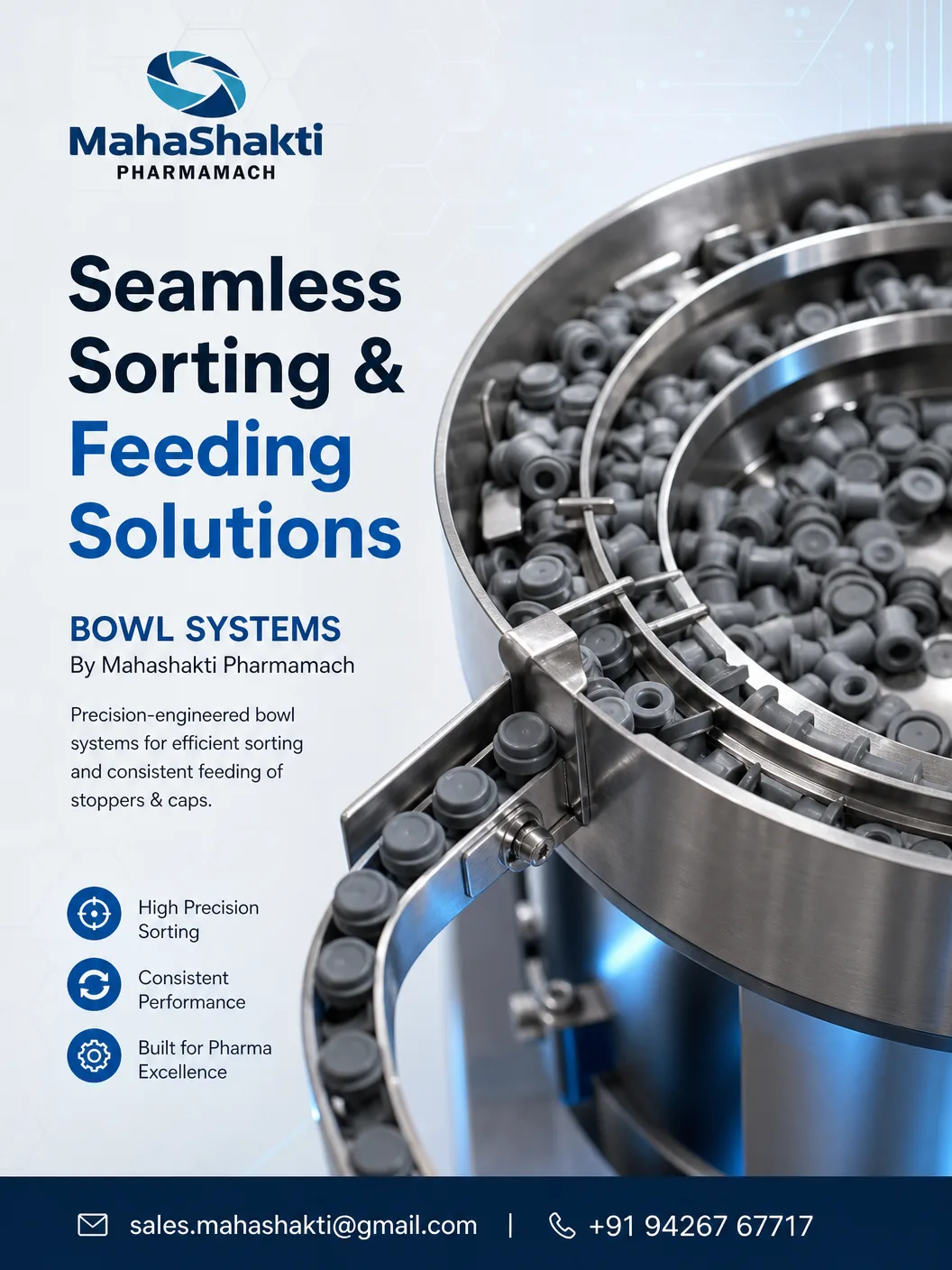
What tends to separate a feeder that runs clean from one that jams is rarely the headline spec — it is the bowl’s internal track geometry, the surface finish on contact points, and how well the vibratory drive is matched to the container shape and weight. A feeder tuned for 2ml vials will not behave the same way with 10ml vials unless the track and amplitude settings are reworked, and this is where a lot of off-the-shelf suppliers fall short. Mahashakti Pharmamach engineers each bowl feeding system around the actual container profile, fill volume, and line speed the client runs, rather than supplying a generic unit and asking the plant to adjust around it.
Our Bowl Feeding Systems Manufacturing Capabilities
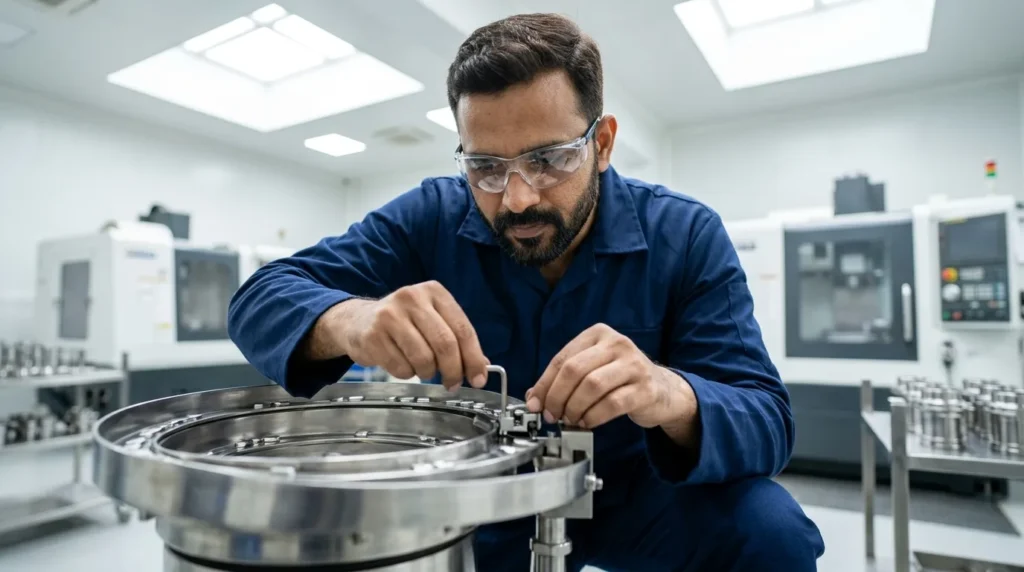
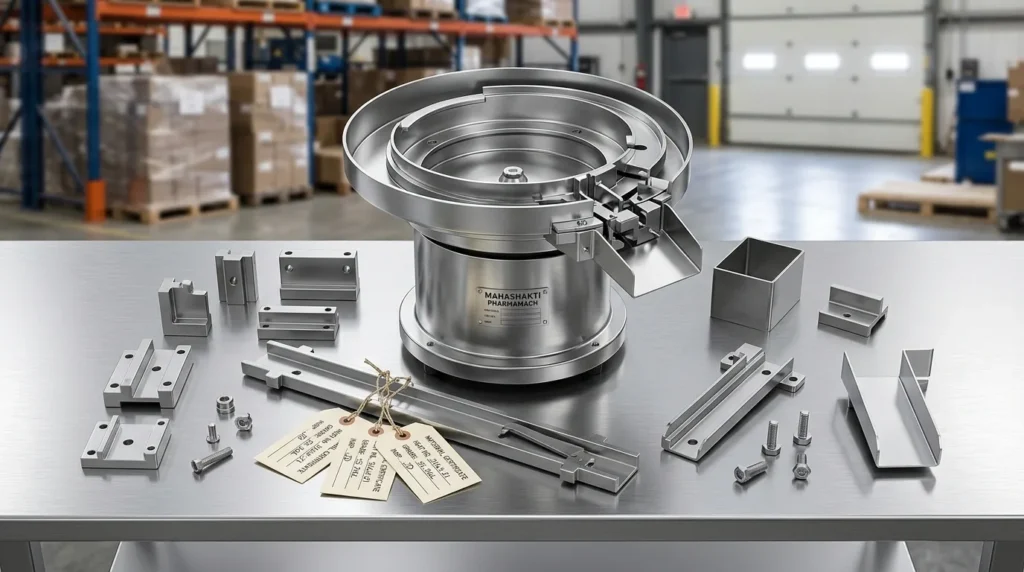
Here’s how Mahashakti Pharmamach approaches bowl feeder manufacturing: every unit starts with precision CNC machining of the bowl body and track inserts, using stainless steel grades that hold up to repeated CIP/SIP cycles without pitting. This matters more than it sounds — a bowl that develops micro-scratches after a few months of cleaning starts collecting residue in those scratches, and that is a contamination risk no QA head wants to explain during an audit.
The company’s current production capacity runs between 10,000 and 50,000+ components per month, which includes bowl feeders, vial washing parts, liquid filling needles, PFS components, and cap sealing rollers manufactured on the same shop floor. This matters for plants that need matched components — a bowl feeder that hands off smoothly to a downstream washing or filling unit reduces the small alignment losses that add up over a shift. Mahashakti Pharmamach also keeps low MOQ spare parts available, which is genuinely useful for mid-sized plants in places like Indore or Vadodara that cannot justify ordering a hundred units of a custom change format part just to keep a single line running.
For export clients in UAE, parts of Africa, and Nepal, every bowl feeding system ships with full dimensional reports and material certificates, since customs and receiving QA teams in those markets often ask for documentation that domestic buyers sometimes skip.
Navigating Quality Standards & GMP Compliance
Yes, we provide full traceability documentation with every bowl feeding system, and this is not optional paperwork — it is what keeps a plant’s batch records defensible. Pharma machinery components, including feeders and change parts, are generally expected to align with GMP principles around material contact surfaces, cleanability, and documented sourcing, broadly consistent with the frameworks referenced by the World Health Organization’s GMP guidelines and ISO quality management standards such as ISO 9001.
In practice, this means every bowl feeder leaving the Mahashakti Pharmamach facility comes with a material test certificate, a dimensional inspection report, and a traceability number that links back to the raw material batch. For plants in Hyderabad and Bangalore working with international biotech clients, this documentation often gets requested during pre-audit walkthroughs, and having it ready in advance — rather than scrambling to source it after a finding — saves real time.
One practical insight from years on the floor: contamination findings during audits are far more often traced to surface finish degradation on older change parts than to the feeder’s core mechanism. Plants that schedule a surface-finish check every 12–18 months, rather than waiting for a visible defect, tend to avoid the bigger compliance headaches later.
Local Suppliers vs Mahashakti Pharmamach
Plants in cities like Surat, Pune, and Chandigarh often start by checking what is available nearby before widening the search. The table below lays out the practical differences buyers tend to find between a typical local fabricator and a dedicated change format parts manufacturer in Ahmedabad with pharma-specific engineering experience.
| Parameter | Typical Local Fabricator | Mahashakti Pharmamach |
|---|---|---|
| Material Traceability | Often informal or unavailable | Full documentation with every batch |
| Pharma-Specific Design Experience | Variable, general engineering background | 15+ years focused on pharma change parts |
| Minimum Order Quantity | Often high to justify setup | Low MOQ spare parts supported |
| Export Documentation | Rarely standardized | Export-ready for UAE, Africa, Nepal |
| Surface Finish for Sterile Contact | Inconsistent across batches | Controlled finish, audit-ready reporting |
| Turnaround for Custom Change Parts | Depends on local workload | Dedicated capacity for pharma clients |
This is not to say local fabricators have no place — for a quick mechanical bracket or a non-contact part, a nearby workshop in Jaipur or Kolkata might be perfectly fine and faster. The distinction matters most for sterile-contact components like bowl feeders, vial washing parts, and filling needles, where documentation and finish consistency directly affect compliance risk.
Step-by-Step Process – How We Deliver Reliable Bowl Feeding Systems for Pharma?
- Requirement mapping – The team reviews container dimensions, fill volume, line speed, and existing machine interface before any drawing is made. A feeder designed without this step is the most common reason plants in Chennai and Delhi report mismatched orientation on receipt.
- Design and drawing approval – A detailed drawing is shared for client sign-off, including track geometry and material specification, before machining begins.
- CNC machining – Precision machining of the bowl, track, and base components using pharma-grade stainless steel.
- Surface finishing – Contact surfaces are finished to the roughness level appropriate for sterile or near-sterile contact, depending on the application.
- Dimensional and functional inspection – Each unit is checked against drawing tolerances before dispatch, with the inspection report kept on file.
- Documentation packaging – Material certificates, traceability numbers, and dimensional reports are compiled and shipped with the unit.
- Dispatch and installation support – Pan-India supply covers metros and tier-2 cities alike, including Mumbai, Ahmedabad, Indore, and Vadodara, with phone-based installation guidance available on request.
Real Client Case Study
The following is a composite, illustrative example built from patterns seen across multiple client engagements, with details adjusted to protect confidentiality.
A mid-sized injectable manufacturing unit near Vadodara was running a vial line where the bowl feeder needed manual intervention roughly twice per shift, mostly due to vial tipping at the bowl-to-track handoff. The plant’s maintenance head had already tried adjusting amplitude settings without lasting improvement. After reviewing the container profile and the existing track geometry, the recommendation was a redesigned track insert with a tighter clearance tolerance matched to the specific vial’s base diameter, along with a revised vibratory amplitude setting.
Following installation of the redesigned bowl feeding system, the plant reported a meaningful drop in manual interventions during trial shifts, along with smoother handoff to the downstream filling station. While exact figures vary by line and operator, this pattern — most feeder issues tracing back to a mismatch between track geometry and container shape rather than the drive mechanism itself — shows up repeatedly across plants in Surat, Pune, and Ahmedabad running similar vial formats.
The broader lesson for procurement and plant heads: when a feeder underperforms, it is worth checking the track-to-container fit before assuming the feeder itself is faulty or needs full replacement.
If your plant is evaluating a feeder replacement or redesign, a Free Spare Parts Consultation is a low-friction way to get a second opinion on whether the issue is mechanical, geometric, or settings-related before committing to new tooling. You can also request the Pharma Machinery Parts Cost Guide, which breaks down typical cost ranges for feeders, change parts, and related components, to help with budgeting before a formal quote.
Faqs
1. What are reliable bowl feeding systems in pharmaceutical manufacturing?
- Reliable bowl feeding systems are automated machines that sort, orient, and feed pharmaceutical components like rubber stoppers, caps, and closures with high precision. They improve production speed, reduce manual handling, and ensure consistent product quality while meeting GMP standards.
2. Why are bowl feeding systems important for pharma production?
- Bowl feeding systems help pharmaceutical manufacturers achieve accurate component feeding, minimize contamination risks, reduce downtime, and increase packaging efficiency. They play a crucial role in maintaining consistent production quality.
3. Which pharmaceutical components can bowl feeding systems handle?
- Modern bowl feeding systems can efficiently handle rubber stoppers, flip-off caps, plastic caps, aluminum caps, vial components, and other pharmaceutical closures. They can also be customized for different product sizes and production requirements.
4. Pharma bowl feeding system choose karte waqt kin baaton ka dhyan rakhna chahiye?
- Ek reliable bowl feeding system choose karte waqt machine ki accuracy, speed, material quality (SS316L), GMP compliance, easy cleaning, low maintenance aur customization options ko zaroor check karein. Trusted manufacturers jaise Mahashakti Pharmamach better long-term performance provide karte hain.
5. Kya bowl feeding systems contamination ko kam karte hain?
- Haan. Automated bowl feeding systems manual handling ko significantly reduce karte hain, jisse contamination ka risk kam hota hai. Isse pharmaceutical production hygienic, efficient aur regulatory standards ke according rehta hai.
6. Mahashakti Pharmamach ke bowl feeding systems kaise alag hain?
- Mahashakti Pharmamach offers precision-engineered bowl feeding systems designed for high-speed, reliable, and consistent performance. Their machines support GMP-compliant pharmaceutical production with customizable solutions, durable construction, and dependable after-sales service.
7. Can bowl feeding systems be customized for different pharma production lines?
- Yes. Reliable bowl feeding systems can be customized based on component type, production capacity, feeding orientation, automation level, and available floor space. Custom solutions help pharmaceutical manufacturers improve efficiency and productivity.