
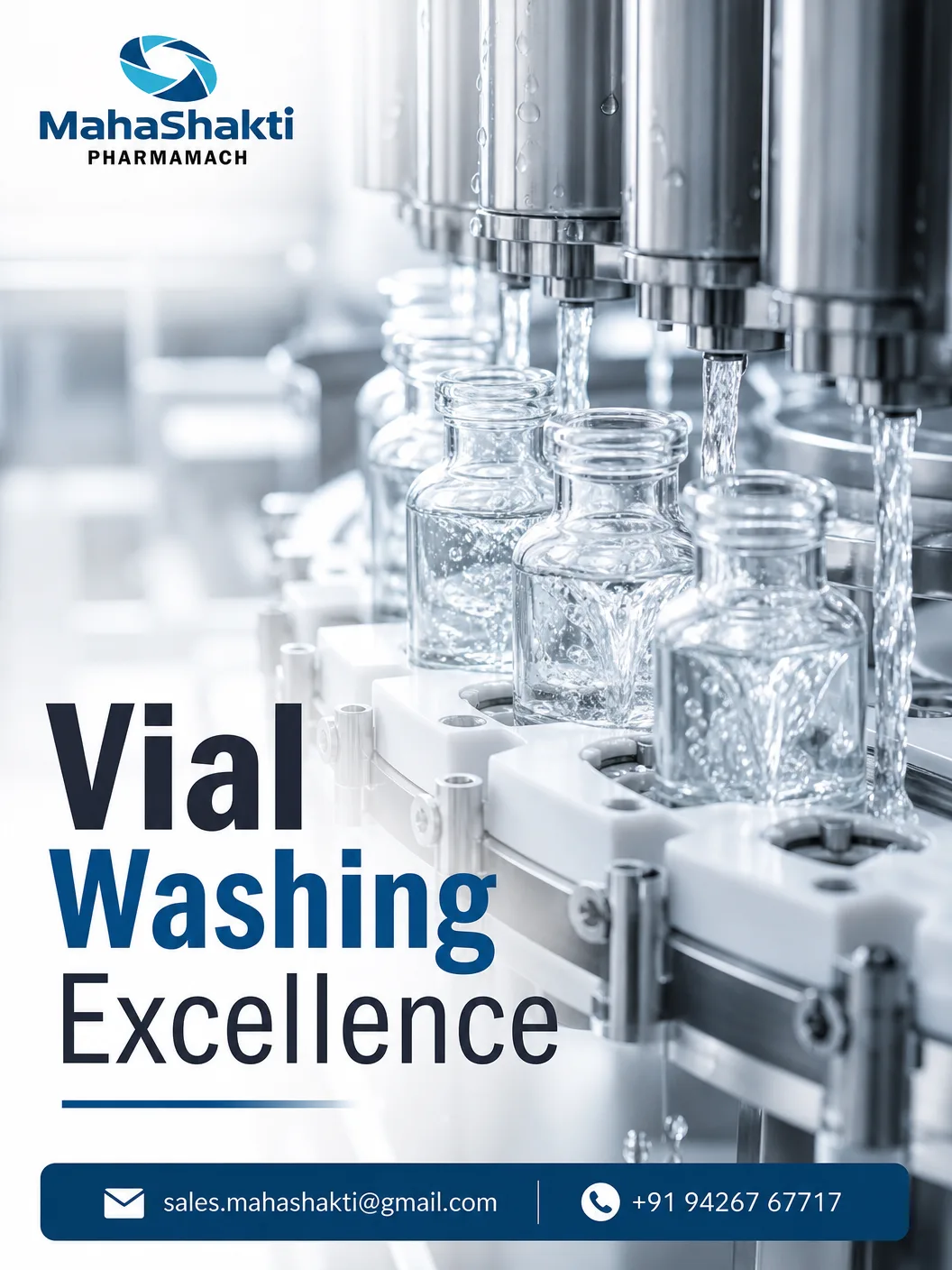
Advanced Vial Washing Solutions for Pharmaceuticals: A Plant Head’s Guide to Choosing the Right Spare Parts Partner
If you have ever stood on a pharma shop floor at 2 AM watching a vial washing line stall because a worn nozzle finally gave up, you already know why this topic matters more than most procurement teams realise. A vial washing machine is only as reliable as its weakest spare part, and in sterile manufacturing, “weakest” is not a word you want anywhere near your production schedule. Mahashakti Pharmamach has spent over 15 years solving exactly this problem for pharma companies across India, supplying precision-engineered Advanced Vial Washing Solutions for Pharmaceuticals, change format components, and sterile tooling that keep washing lines running within validated parameters. This article walks through what actually goes into reliable vial washing spares, how GMP compliance fits into part selection, and what a real change-format project looks like from enquiry to delivery.
Why Choose Mahashakti Pharmamach for Advanced Vial Washing Solutions for Pharmaceuticals?
The best vial washing spare parts are the ones nobody notices — because the line never stops. That sounds simple, but achieving it consistently requires tight tolerances, the right material grade, and a manufacturer who understands how vial washing machines actually behave under continuous production load, not just what a drawing says on paper.
Mahashakti Pharmamach was founded by Mr. Bipin Panchal, who built the company on a fairly old-fashioned idea: spend more time on the shop floor with the customer’s machine than in the sales conversation. That approach has translated into parts supplied to 200+ pharma companies across India, with a production capacity of 10,000 to 50,000+ components per month, and an export footprint covering UAE, Africa, and Nepal. None of those numbers matter on their own — what matters is that they reflect repeat business from plants that came back after the first nozzle, the first cup holder, or the first set of spray jets performed exactly as specified.
Here’s how Mahashakti Pharmamach approaches pharma machinery spare parts manufacturers work differently from a typical local fabricator: every component starts with the actual machine make and model, not a generic catalogue number. A vial washing nozzle for a rotary washer behaves very differently from one designed for an inline machine, and treating them as interchangeable is one of the more common (and expensive) mistakes plant teams make when sourcing in a hurry.
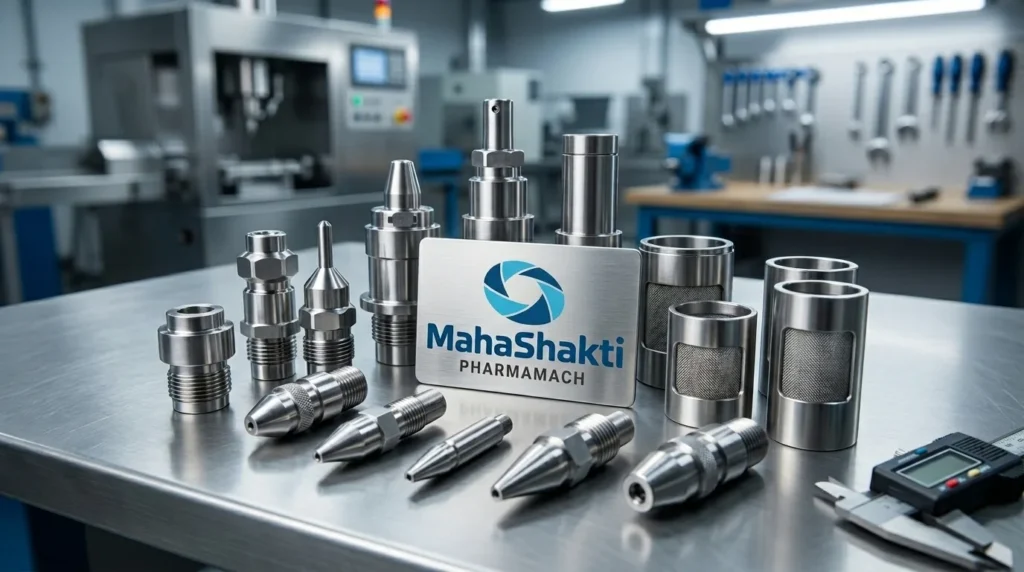
Our Advanced Vial Washing Solutions for Pharmaceuticals Manufacturing Capabilities
Yes, we provide a full range of vial washing parts — spray nozzles, water and air jets, vial holding cups, rotating star wheels, change parts for different vial sizes, and the connecting tooling that ties these into your existing washing station. But the capability that actually matters to a plant head is consistency across batches, because a part that fits perfectly today and loosely six months later is not a part you can trust during an audit.
CNC precision manufacturing is the backbone of this consistency. Every custom change format part is machined to tolerances that match the original equipment specification, then checked against the actual vial dimensions the customer runs — because vial neck diameters and shoulder heights vary more than people expect across different glass vendors. A Surat-based injectable manufacturer once mentioned that their previous supplier’s change parts worked fine with one glass batch and jammed with the next; the issue traced back to inconsistent machining, not the glass.
Beyond vial washing, the broader capability set includes liquid filling needles, PFS components for pre-filled syringe lines, cap sealing rollers, and sterile tools and accessories used across filling and sealing stations. Manufacturing all of these under one roof means a plant in Pune or Hyderabad running both a washing line and a filling line from the same machinery family can source matched components without juggling multiple vendors and multiple lead times.
Low MOQ is also part of the manufacturing philosophy here. A mid-sized formulation unit in Indore doesn’t always need a thousand pieces of a spare part — sometimes it’s twelve nozzles to get through the next three production cycles while a larger order is finalised. Low MOQ spare parts availability matters more to working capital than most cost sheets show.
Navigating Quality Standards & GMP Compliance
Pharma machinery spare parts sit in an unusual position — they are not the drug product, but they touch it directly during washing, filling, and sealing, which means quality expectations are closer to pharmaceutical manufacturing than general engineering.
GMP compliant parts start with material traceability. Every batch of stainless steel or compatible polymer used in a vial washing component should be traceable back to its source mill certificate, because an FDA or WHO-GMP auditor in Chandigarh or Vadodara will ask for exactly that during a facility inspection, and “we’ll check with our supplier” is not an answer anyone wants to give mid-audit.
GMP guidelines, as outlined by the World Health Organization, emphasize documented control over materials and processes that come into contact with pharmaceutical products — a principle that extends naturally to the spare parts feeding washing and filling equipment. Similarly, ISO quality management standards focus on consistent, repeatable manufacturing processes rather than one-off inspection — which is precisely why audit-ready documentation matters more than a single quality certificate sitting in a file somewhere.
Mahashakti Pharmamach maintains GMP aligned processes with ISO standards as the manufacturing baseline, paired with full material traceability and documentation that plant QA teams can hand directly to auditors. For a Bangalore-based biotech client preparing for a regulatory inspection last year, having that documentation ready in advance — rather than scrambling to request it after the audit notice arrived — made a measurable difference in how smoothly the inspection went.
Local Suppliers vs Mahashakti Pharmamach
Procurement teams across Mumbai, Delhi, and Chennai often start with a local fabricator simply because it’s nearby and fast for a quote. That’s a reasonable starting point, but the comparison usually looks different once you factor in documentation, consistency, and what happens when the order needs to scale.
| Factor | Typical Local Supplier | Mahashakti Pharmamach |
|---|---|---|
| Material Traceability | Often informal or unavailable | Full traceability with mill certificates |
| Tolerance Consistency | Varies by operator and batch | CNC precision, batch-to-batch consistency |
| GMP/ISO Documentation | Limited or case-by-case | GMP aligned, ISO standard, audit-ready |
| MOQ Flexibility | Sometimes high minimums | Low MOQ supported |
| Pan-India & Export Supply | Usually regional only | Pan-India supply; exports to UAE, Africa, Nepal |
| Track Record | Variable | 15+ years, 200+ pharma clients served |
This isn’t to say every local supplier falls short — many do solid work for general fabrication. The gap tends to show up specifically when sterile, GMP-relevant components are involved and documentation requirements increase.
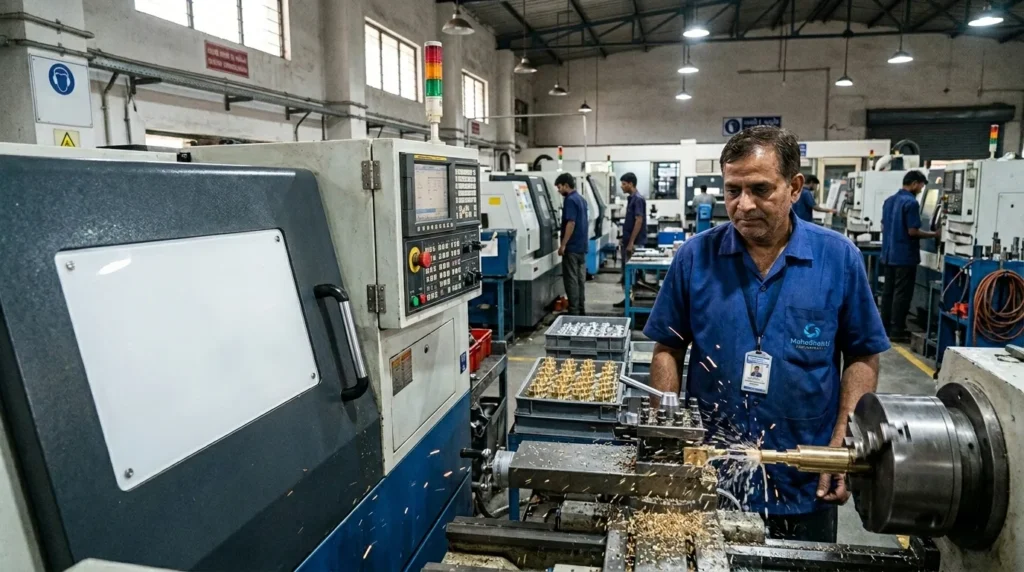
Step-by-Step Process – How We Deliver Advanced Vial Washing Solutions for Pharmaceuticals
The best results in this category come from a process that resists shortcuts, even when a customer is under deadline pressure — which, in pharma manufacturing, is more often than not.
- Technical discussion and machine assessment — understanding the exact vial washing machine model, current part wear patterns, and vial specifications in use.
- Drawing and sample validation — either working from existing OEM drawings or reverse-engineering from a worn sample part, with dimensional confirmation before bulk production.
- CNC manufacturing — precision machining under controlled tolerances, batch-tested for dimensional consistency.
- Material certification check — confirming traceability documentation against the agreed material specification.
- Quality inspection — dimensional and visual inspection against the validated sample or drawing.
- Dispatch with documentation — pan-India logistics or export packaging for UAE, Africa, and Nepal, with traceability paperwork included.
A Jaipur-based contract manufacturer once needed an emergency reorder of vial holding cups after a sudden spike in batch volume. Because the original drawings and material specs were already on file from a prior order, the second batch moved through manufacturing without repeating the validation step from scratch — which is really the practical benefit of working with the same supplier consistently rather than re-sourcing every time.
Real Client Case Study
A mid-sized injectable manufacturing unit near Ahmedabad — we’ll refer to them as a regional sterile formulations company — was facing repeated downtime on their vial washing line, traced eventually to inconsistent spray nozzle performance after roughly four months of use. Their existing supplier could not provide material traceability documentation when the client’s QA team requested it ahead of an internal audit.
Mahashakti Pharmamach was approached for a full assessment. The team reviewed the existing nozzle design, identified that the material grade being used was not optimal for the water quality and pressure profile of that specific washing station, and proposed a revised specification along with full documentation. After switching, the client reported a noticeably longer service life on the replacement nozzles and, just as importantly, had the traceability paperwork ready well before their next audit cycle. It’s a fairly typical story in this industry — the part itself is rarely the only issue; matching the part correctly to the actual operating conditions usually is.
For plants in Kolkata, Indore, or anywhere else dealing with similar wear patterns, this kind of root-cause assessment — rather than a straight like-for-like replacement — tends to be where the real value shows up.

Frequently Asked Questions
1. What is a vial washing machine?
- A vial washing machine is pharmaceutical equipment designed to clean glass vials using purified water and sterile air before filling, ensuring contamination-free production and GMP compliance.
2. Why is vial washing important in pharmaceutical manufacturing?
- Vial washing removes dust, particles, and contaminants from vials, helping manufacturers maintain product quality, sterility, and regulatory compliance.
3. Which industries use vial washing machines?
- Vial washing machines are widely used in pharmaceutical, biotechnology, vaccine, injectable, and healthcare manufacturing facilities.
4. What features should you look for in a vial washing machine?
- Choose a machine with automated washing cycles, GMP-compliant design, low water consumption, high efficiency, easy maintenance, and reliable performance.
5. Vial washing machine ka use kis liye hota hai?
- Vial washing machine glass vials ko filling se pehle properly clean karti hai, jisse contamination kam hota hai aur pharmaceutical quality maintain rehti hai.
6. Pharma company ko automatic vial washing machine kyun choose karni chahiye?
- Automatic machine fast production, consistent cleaning, kam manual handling aur GMP standards maintain karne me help karti hai.
7. Mahashakti Pharmamach ki vial washing machine ki khasiyat kya hai?
- Mahashakti Pharmamach ki machines reliable performance, GMP-compliant design, easy operation aur long-term durability ke liye trusted hain.