Reliable Pharmaceutical Vial Sealing Technology — Manufacturing Insights from Mahashakti Pharmamach
Vial sealing is one of those operations on the shop floor that nobody talks about until it goes wrong. A loose crimp, an inconsistent cap seal roller, or a worn-out change part can cost a pharma plant an entire batch — and in regulated environments, a failed seal integrity test means rework and documentation headaches. After 15+ years working with pharma machinery spare parts manufacturers and plant teams across India, we’ve seen the same pattern repeatedly: sealing reliability comes down to the precision of the parts feeding the machine, not just the machine itself. This article walks through how Mahashakti Pharmamach approaches reliable pharmaceutical vial sealing technology — from component design to GMP documentation — based on real production experience.
Why Choose Mahashakti Pharmamach for Reliable Pharmaceutical Vial Sealing Technology?
Mahashakti Pharmamach has been manufacturing precision spare parts for pharmaceutical machinery for over 15 years, operating out of Vatva GIDC, Ahmedabad — one of India’s most concentrated pharma manufacturing belts. The company is led by Mr. Bipin Panchal, whose background in CNC precision engineering shaped how the workshop approaches every component: tight tolerances, traceable raw material, and documentation that holds up during a regulatory audit.
The best way to judge a vial sealing parts supplier isn’t the brochure — it’s whether their cap sealing rollers, crimping jaws, and sealing heads maintain consistent pressure across a full shift without drift. Over the years, the team has supplied change format parts manufacturers in Ahmedabad and beyond with components that hold dimensional accuracy well within pharma-grade tolerance bands, directly reducing seal rejection rates on the line.
Sealing performance is rarely about one part. It’s the interaction between the cap sealing roller, the vial holder, the crimping head, and the format-specific change parts that determines whether a batch passes seal integrity testing. Mahashakti Pharmamach designs these as a system, drawing on feedback from over 200 pharma companies that have used their components in real production environments.
Our Vial Sealing Technology Manufacturing Capabilities
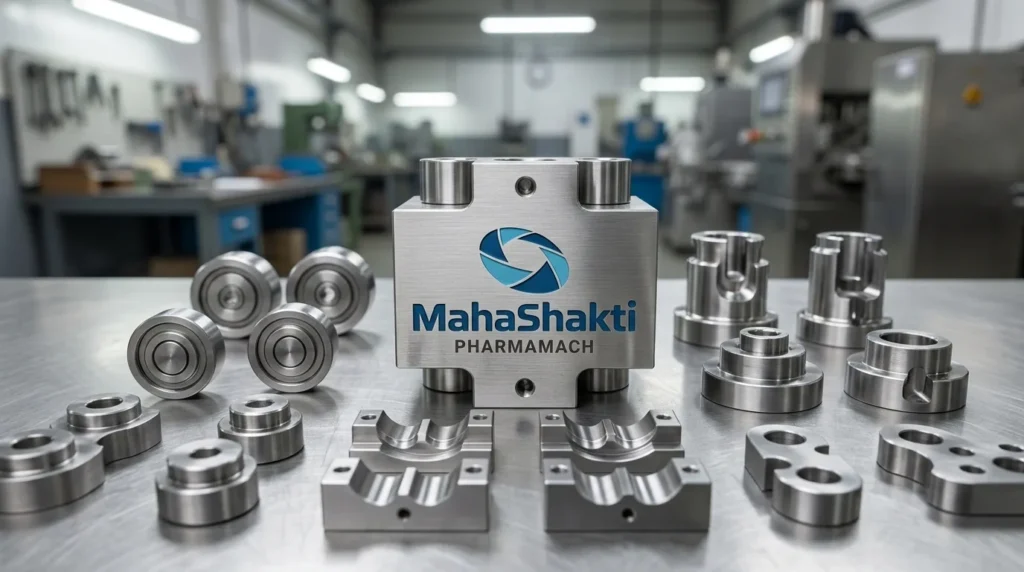
Yes, we provide complete sealing-line spare part support — not just one component in isolation. Manufacturing capability at Mahashakti Pharmamach spans:
- Cap sealing rollers machined to match specific crimping head profiles, used in aluminium cap sealing for vials of varying neck diameters
- Crimping jaws and sealing heads for rotary and inline sealing machines
- Vial washing parts that feed clean, defect-free vials into the sealing stage, since contamination upstream often shows up as sealing defects downstream
- Liquid filling needles and PFS components for lines combining filling, stoppering, and sealing in one process
- Sterile tools and changeover kits for quick format conversion between vial sizes
Here’s how Mahashakti Pharmamach typically handles a sealing parts order: the team starts with the OEM drawing or a sample of the worn part, verifies critical dimensions on a CMM (coordinate measuring machine), and only then moves to CNC production. This isn’t a generic stocking model — most orders are custom change format parts built to the specific machine running on the client’s floor, whether that’s an OEM import or a domestic Indian line.
Production capacity currently sits between 10,000 and 50,000+ components per month, supporting everything from a plant head ordering replacement crimping jaws to a contract manufacturer in Hyderabad stocking up ahead of a multi-shift expansion. A mid-sized formulation unit near Vadodara recently needed 40 cap sealing rollers reworked to a tighter tolerance after switching to a smaller vial neck — the kind of mid-batch adjustment that happens more often than people expect.
Navigating Quality Standards & GMP Compliance
The biggest mistake plant teams make when sourcing sealing parts is assuming “it fits” is the same as “it’s compliant.” It isn’t. Pharmaceutical vial sealing components sit in direct or near-direct contact with the product path, so material certification and traceability aren’t optional paperwork — they’re what an auditor asks for first.
Mahashakti Pharmamach manufactures parts under GMP-aligned processes, referencing established ISO quality benchmarks for material grade and dimensional consistency (see the ISO standards overview for general reference, and the WHO GMP guidelines for broader regulatory context). Every batch of GMP compliant parts leaving the Vatva facility carries material traceability documentation — meaning a plant’s quality team can trace a sealing roller back to its raw material certificate, not just a part number.
This matters more than people realize. A production head in Chennai once mentioned that during a WHO-GMP inspection, the auditor specifically asked for material certificates on changeover parts installed in the previous six months — not just the machine’s own validation file. Having that traceability ready, rather than scrambling mid-audit, is what separates a reliable vial washing machine parts manufacturer from one that’s just selling metal.
For pharma teams in Mumbai, Delhi, Bangalore, Pune, and Indore running multi-shift operations, this compliance layer matters even more — every new change part introduced to a validated line technically needs documentation and qualification before use.
Local Suppliers vs Mahashakti Pharmamach
| Parameter | Typical Local Supplier | Mahashakti Pharmamach |
|---|---|---|
| Material Traceability | Often missing or informal | Documented, audit-ready |
| Custom Change Format Parts | Limited to standard sizes | Fully custom, drawing-based |
| MOQ (Minimum Order Quantity) | Often high, bulk-only | Low MOQ, suitable for small batches |
| Production Capacity | Varies, often inconsistent | 10,000–50,000+ components/month |
| Export Readiness | Rarely export-documented | Export-ready (UAE, Africa, Nepal) |
| GMP Alignment | Inconsistent across vendors | GMP-aligned across product range |
This comparison isn’t meant to suggest every local supplier falls short — many do solid work for standard parts. But for sealing-critical components, the gap tends to show up during scale-up or audits, not during everyday production.
Step-by-Step Process – How We Deliver Vial Sealing Technology?
- Requirement gathering — the client shares the existing part, OEM drawing, or vial specifications.
- Dimensional verification — incoming samples are measured on CMM equipment to confirm exact tolerances before production.
- Material selection — appropriate grade stainless steel or certified alloy is chosen based on product contact requirements and GMP norms.
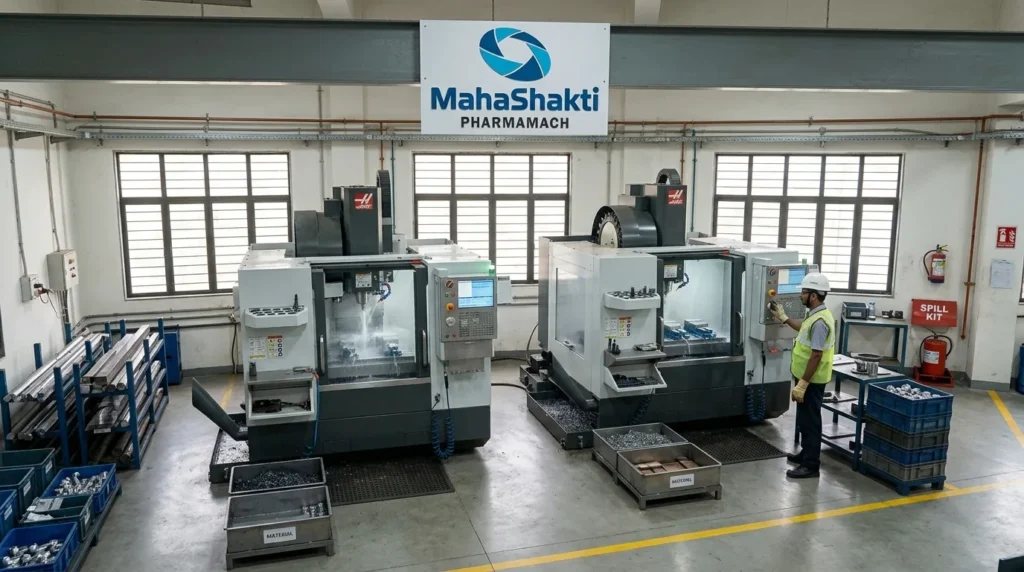
- CNC manufacturing — precision machining of cap sealing rollers, crimping components, or vial handling parts.
- Quality inspection — every batch undergoes dimensional and visual inspection before packing.
- Documentation — material certificates and traceability records are compiled for audit readiness.
- Dispatch — pan-India supply via trusted logistics partners, with export documentation prepared separately for UAE, Africa, and Nepal shipments.
This typically takes a few days for stock-pattern parts to 2–3 weeks for fully custom change format parts, depending on complexity.
Real Client Case Study
A mid-sized injectable manufacturing unit near Surat (referred to here as “Client A” for confidentiality) was facing a recurring issue: roughly 3-4% of vials were failing seal integrity checks during high-speed runs, and the existing cap sealing rollers showed visible wear after just a few months.
The Mahashakti Pharmamach team requested the worn rollers along with the machine’s technical specs. Dimensional analysis showed the rollers had drifted nearly 0.05mm from original tolerance — small on paper, but enough to cause inconsistent crimp pressure at speed. New rollers were CNC-machined to OEM tolerance using a harder-wearing material grade, along with matched crimping jaws.
After installation, the client reported seal rejection rates dropping below 0.5% over the next two production cycles, with minimal roller wear after several months of multi-shift operation. Sealing problems often trace back to gradual component wear that’s easy to overlook until rejection data forces the question.
In a smaller case, a contract packaging unit in Jaipur needed a quick turnaround on vial washing parts ahead of a client audit; same-week dispatch of low-MOQ parts helped them avoid a production delay.
FAQ – Reliable Pharmaceutical Vial Sealing Technology
1. What is pharmaceutical vial sealing technology?
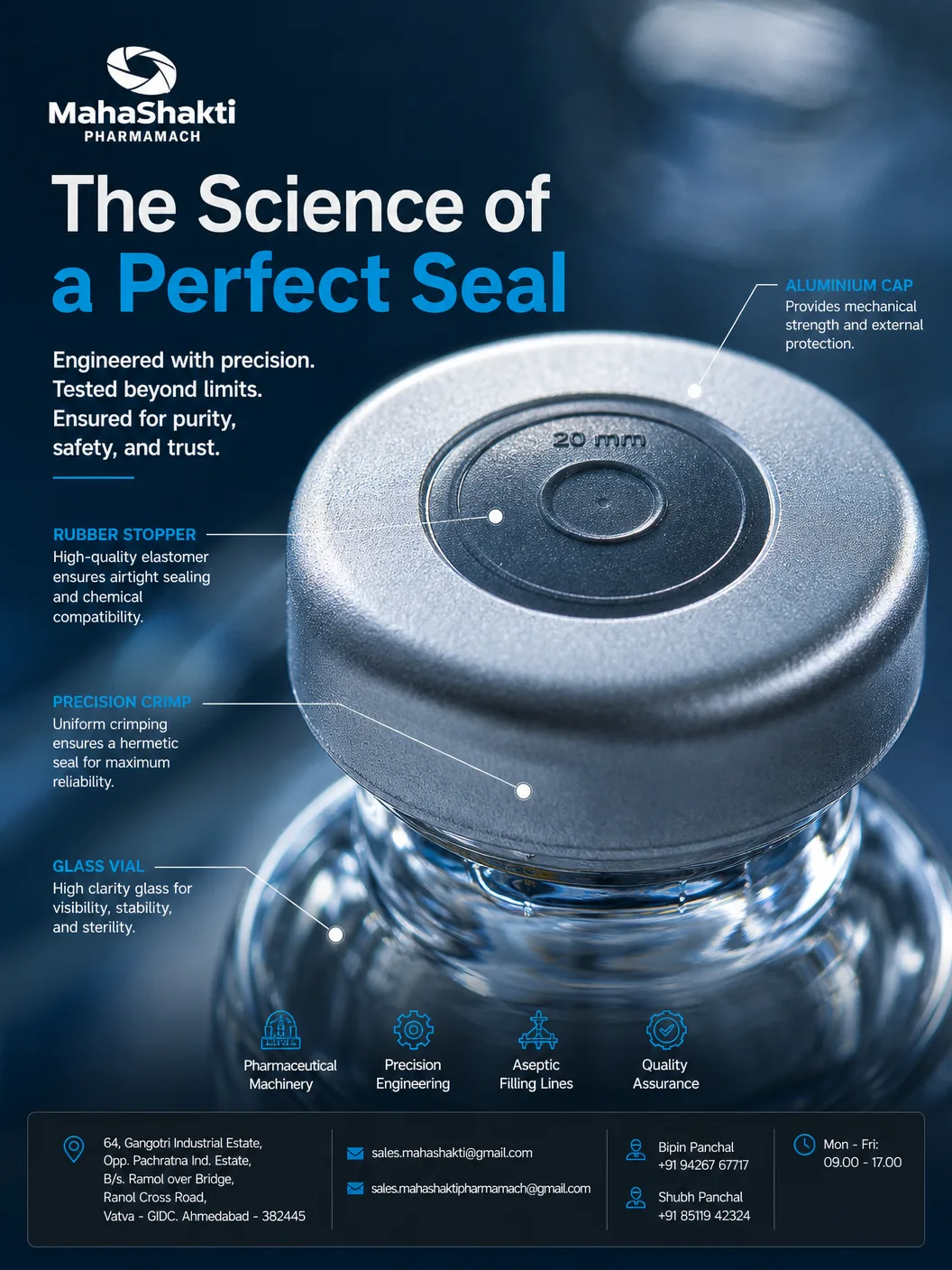
- Pharmaceutical vial sealing technology is the process of securely closing a vial using a rubber stopper and aluminum cap to maintain sterility, prevent contamination, and ensure drug stability throughout storage and transportation.
2. Why is vial sealing important in pharmaceutical manufacturing?
- Reliable vial sealing protects injectable medicines from moisture, oxygen, microorganisms, and external contaminants. It also helps pharmaceutical manufacturers comply with GMP and regulatory requirements.
3. How does a rubber stopper contribute to vial integrity?
- A high-quality rubber stopper creates an airtight barrier between the drug product and the external environment, helping maintain sterility, chemical compatibility, and container closure integrity.
4. Pharma vial sealing machine ka main purpose kya hota hai?
- Pharma vial sealing machine ka main purpose rubber stopper aur aluminum cap ko accurately seal karna hota hai, jisse injectable products contamination-free aur safe rahen.
5. Vial sealing process me aluminum cap kyu use kiya jata hai?
- Aluminum cap mechanical protection provide karta hai aur rubber stopper ko securely hold karta hai, jisse seal integrity aur product safety maintain rehti hai.
6. Kya automated vial sealing machines production efficiency badhati hain?
- Haan, automated vial sealing machines high-speed operation, consistent crimping, reduced human intervention, aur better quality control provide karti hain, jisse overall manufacturing efficiency improve hoti hai.
7. What factors should buyers consider when selecting a vial sealing machine?
- Buyers should evaluate sealing accuracy, production capacity, GMP compliance, automation level, maintenance requirements, container closure integrity performance, and after-sales support before selecting a vial sealing machine.